

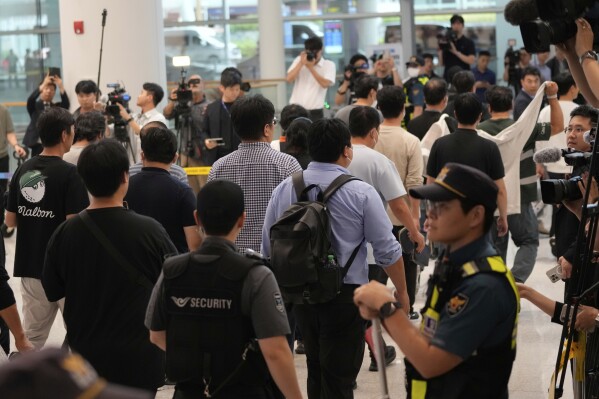
More than 300 South Korean nationals have returned home after being detained in a U.S. immigration raid at a Hyundai factory in Georgia. They arrived at Incheon International Airport on Friday aboard a chartered Korean Air flight from Atlanta. Fourteen non-Korean workers also flew back, while one South Korean chose to remain in the U.S. to seek residency.
The mass arrests triggered sharp diplomatic tension between Washington and Seoul. Both South Korea’s president and Hyundai’s chief executive warned that the raid could harm business ties.
White House Delays Departure
South Korean President Lee Jae Myung said the workers’ return was delayed more than a day. According to him, President Donald Trump ordered officials to check whether some wanted to stay for training before being sent home.
At the Seoul airport, the workers looked relieved but exhausted as security escorted them through the terminal. Some shouted, “I’m back, I’m free,” while reuniting with their families.
Crowds of reporters and protesters waited at the scene. Demonstrators carried banners blasting the raid. One showed Trump in an immigration officer’s uniform with the caption: “We’re friends! Aren’t we?” Another read: “Why invest in the U.S. after such betrayal?”
South Korea’s foreign ministry urged the media to protect workers’ privacy by blurring faces in photos and video.
Controversial Crackdown
The raid happened last week when U.S. agents detained 475 workers at Hyundai’s battery plant in Georgia. Over 300 were South Korean citizens. Authorities said many had entered the U.S. on short-term visas or visa waivers and were working illegally.
Eyewitnesses described panic as agents handcuffed mechanics contracted to install production lines. Photos of chained workers spread quickly, sparking outrage in South Korea and fueling fears that Korean companies may pull back investments in America.
President Lee warned that firms could hesitate to expand in the U.S. “It is common for Korean firms to send skilled staff abroad,” he said. “If that is blocked, expansion will become far harder.”
Diplomatic and Business Fallout
South Korea’s foreign minister, Cho Hyun, raised the issue in Washington this week. He asked U.S. senators to explore new visa options for Korean companies.
Hyundai CEO José Muñoz said the raid would delay the plant’s opening by two to three months. “Now all these people want to get back home, so we need to find replacements quickly,” he told U.S. media.
LG Energy Solution, Hyundai’s partner at the site, insisted that many detained staff held legal documents.
A Strained Alliance
The timing of the raid is sensitive, as trade talks between the U.S. and South Korea continue. Major Seoul newspapers described the crackdown as a “shock” and warned it could damage the alliance if left unresolved. Yonhap News Agency said both nations must work together to limit long-term harm.
Trump defended the raid on social media, saying foreign companies should prioritize hiring Americans. He added that his administration would allow more foreign workers only if companies followed immigration rules.
For now, the workers’ return has calmed tensions at home. Still, questions remain about whether South Korea will keep investing billions in U.S. manufacturing after this highly charged episode.
Resources:
www.bbc.com
knowledgenexuses.com