

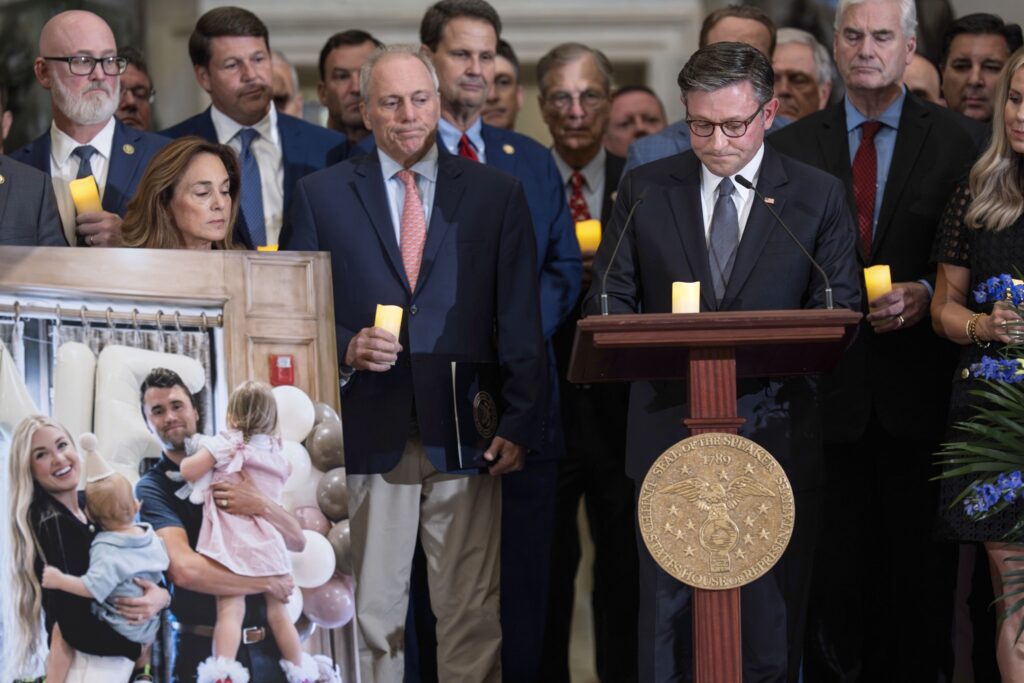
This week, House Speaker Mike Johnson gathered members of Congress to honor conservative activist Charlie Kirk. During the memorial, the Louisiana Republican described the shock on Capitol Hill.
“For many of us, it feels as though the ground itself has shifted,” Johnson said.
The murder of Kirk, founder of Turning Point USA, has shaken lawmakers in both parties. As a result, long-standing concerns about safety have intensified in an already tense political climate. Threats and calls to violence are becoming alarmingly common.
Senate Moves First, House Plans to Follow
In response, Senate Majority Leader John Thune of South Dakota secured unanimous approval of a measure on Thursday night. The plan allows senators to use their official office budgets for security needs.
Meanwhile, House members are pressing for similar funding increases. This marks a significant change in attitude, since many now believe that public service demands the same precautions once reserved for presidents and cabinet members.
Sen. James Lankford, R-Okla., explained the shift. “A few years ago we all knew there was some risk. Now, families and staff are asking what steps we are taking to stay safe,” he said.
Limited Protection Outside the Capitol
Unlike the president or senior executive officials, most senators and representatives do not have security agents when they leave the Capitol complex. The complex itself is guarded by the U.S. Capitol Police.
Therefore, some lawmakers hire private guards and pay for them with campaign or personal funds.
Rep. Greg Casar, D-Texas, noted that “members of Congress actually get less protection than many local officials or judges back home. Often, we are the least secure.”
Casar warned that political violence aims to silence elected voices. “We cannot allow that if democracy is to survive,” he said.
Threat reports handled by the Capitol Police have risen for four straight years. According to the department, more than 9,000 threats were tracked in 2024, and the total may reach about 14,000 by the end of 2025.
Funding Proposals Gain Support
“This is a national security matter, and we are taking it very seriously,” said Florida Rep. Anna Paulina Luna. She and other Republicans met with Speaker Johnson several times this week to push for stronger funding in the federal budget.
Luna explained that many lawmakers face credible threats against themselves and their families. These threats are under active investigation. Consequently, members routinely deal with death threats, bomb scares, false “swatting” calls, and vandalism of their offices.
“We have needed this for a long time,” Luna said. “It is tragic that it took such a horrific event to force action, but it must be addressed.”
The House, which is controlled by Republicans, has passed a government spending bill that adds about $88 million for security upgrades for lawmakers, Supreme Court justices, and certain executive branch officials.
New Security Programs
A temporary House program that provides monthly stipends for protection doubled its allowance this year to $10,000 per member. The program began in July after the assassination of Minnesota state Rep. Melissa Hortman and her husband.
Through this program, House members can also spend up to $20,000 on home security equipment.
However, the extra money does not affect the president, who is covered by the Secret Service, or the Capitol Police budget that protects the Capitol complex, the Supreme Court, the Library of Congress, and other government buildings.
Rep. Maxwell Frost, D-Fla., called it “ridiculous” that lawmakers must use personal or campaign funds for protection. “Federal judges have marshals. The executive branch has dedicated law enforcement. Yet, members of Congress remain largely unprotected,” he said.
Growing Pressure From Both Parties
Rep. Tim Burchett, R-Tenn., criticized party leaders for not doing more. He argued that top leaders travel in protected motorcades and rarely face the daily risks encountered by rank-and-file members. “They live inside a security bubble,” Burchett said. “Meanwhile, we stand in crowds and wait in lines with our families. That’s frightening.”
Wisconsin Republican Derrick Van Orden said the FBI is investigating multiple death threats against his family. He urged prosecutors to treat such threats as acts of terrorism. “We have some security,” Van Orden said, “but it is not enough.”
Utah Rep. Blake Moore, vice chair of the House Republican Conference, pointed to broad bipartisan agreement that Congress must do more. “We need to balance fiscal responsibility with real protection,” he said.
Coordination With Local Police
Local law enforcement agencies often provide support when lawmakers hold events in their districts. Nevertheless, members say travel between their home states and Washington still leaves them exposed.
Rep. Debbie Wasserman Schultz, D-Fla., is calling for a comprehensive security strategy that includes staff to accompany members during travel. In the past she resisted extra barriers between herself and constituents. However, recent high-profile attacks including the 2011 shooting of her friend, former Rep. Gabby Giffords, D-Ariz. have changed her mind.
“It has become a necessity,” Wasserman Schultz said. “We need to protect constituents, lawmakers, staff, and families. The risk is simply too great to ignore.”
Resources:
https://www.politico.com/
https://knowledgenexuses.com/